Lease Abstraction Software for Property Managers
20 May 2026 · 5 min read
A missed lease expiry date is not just an administrative oversight. It can mean a tenancy rolls on under outdated terms, a rent review window closes, or a break clause lapses because no one flagged it in time.
Property managers running portfolios of 20, 50, or 200 units face this risk every day. Lease agreements are long documents. Critical dates — break clauses, rent reviews, notice periods — are buried in paragraphs of legal text, often worded differently across every agreement in your portfolio.
Tracking them manually in a spreadsheet relies on someone having read the document carefully and entered the right date in the right cell. That is a system built on human attention. Human attention is not reliable at scale.
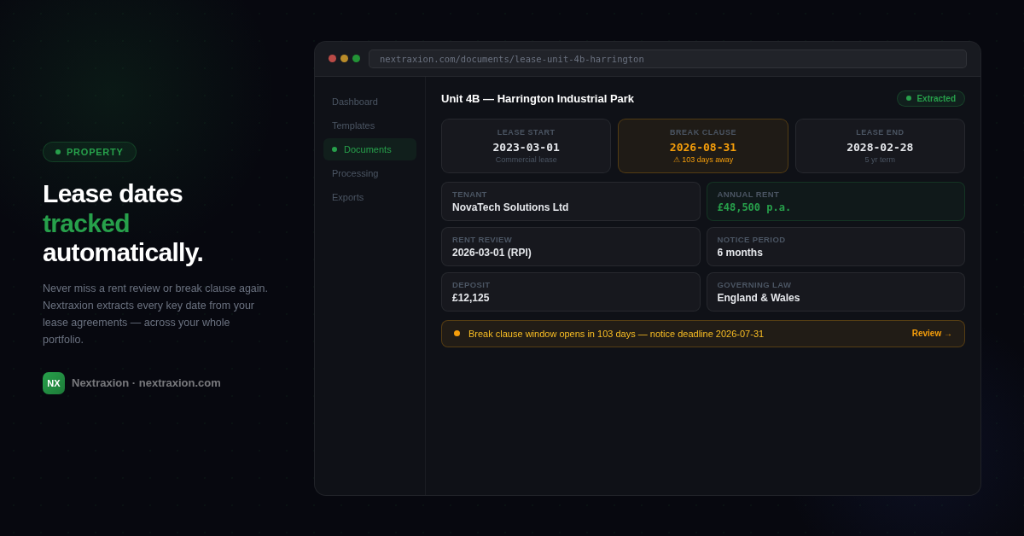
Lease abstraction software replaces the manual read-and-enter step with an automated one. You upload the agreement, and the system returns the key fields as structured data — ready to go into your property management system, calendar, or reporting dashboard. Lease abstraction is the industry term for automatically extracting structured data from lease agreements in this way.
What is lease abstraction software?
Lease abstraction software is the automated process of reading a lease document and pulling out specific data fields — tenant details, financial terms, key dates, and clauses — without requiring manual review. The software uses AI to interpret the natural language in a legal document and identify the relevant information regardless of how it is phrased.
"The tenancy shall commence on", "Lease start date:", and a date appearing after the phrase "from and including" can all be mapped to the same Lease Start Date field. The output is structured data — not a summary of the document, but precise values for each field you need to track and manage.
Why manual lease data processing fails at scale
Critical dates get missed. Rent review dates, break clause windows, and lease expiry dates require action at specific times. If those dates live only in a spreadsheet that someone filled in months ago, there is no guarantee they were entered correctly.
Lease formats vary significantly. A portfolio assembled over years will include agreements drawn up by different solicitors, in different formats, with different clause structures. There is no consistent location for the same information across documents.
Portfolios grow but headcount does not. Adding 20 new properties means 20 more lease agreements to read, log, and track. The administrative burden scales with the portfolio. The team usually does not.
Version and amendment tracking is fragile. When a lease is amended, a new document is added to the file. If the original spreadsheet entry is not updated, your records reflect terms that no longer apply.
What fields can be extracted automatically?
- Tenant name
- Landlord name
- Property address
- Lease start date
- Lease end date
- Rent amount (and frequency)
- Rent review date
- Break clause date
- Notice period required
- Deposit amount
- Permitted use of the property
- Governing law / jurisdiction
Additional fields — such as service charge caps, assignment restrictions, or guarantor details — can be added to your template.
How it works in practice
- Upload the lease agreement — PDF or Word document, individually or in batches.
- Select your template — Use the lease extraction template or configure your own field list.
- Extraction runs automatically — Nextraxion reads the document and returns the values as structured data. Complex documents typically process in under a minute.
- Review the output — Each extracted field is displayed clearly. Review values before accepting, particularly useful for critical dates.
- Export to your system — Download as CSV or push via API to your property management platform.
Who uses this?
Property managers at commercial and residential agencies use lease extraction to build and maintain accurate records across large portfolios. Rather than reading each new agreement in full and manually updating a spreadsheet, the team uploads the document and gets the relevant fields immediately.
Portfolio landlords and asset managers use it to keep track of lease events across properties they own directly. Break clauses and rent review dates have financial implications — knowing they are accurately recorded is a risk management issue as much as an administrative one.
Operations and compliance teams at larger property businesses use it as part of their onboarding process for new acquisitions. When a portfolio of properties changes hands, there are often dozens of lease agreements to review and record. Extraction reduces the time that process takes from days to hours.
Getting started with Nextraxion
Upload a sample lease agreement, map the fields you track, and save your template. Every subsequent lease you run through that template returns the same structured output — consistent, accurate, and ready to use.
There is no legal training required to configure the extraction. You define the fields that matter to your business. Nextraxion handles the document reading. Setup takes under ten minutes, and the first extraction is free.
Frequently asked questions
What data can be extracted from a lease agreement automatically?
Tenant and landlord names, property address, lease start and end dates, annual rent, rent review dates, break clause dates, notice period, deposit amount, permitted use, and governing law. Custom fields like service charge provisions or guarantor details can be added.
Can it identify break clauses automatically?
Yes — regardless of how the clause is phrased, Nextraxion identifies the relevant date and notice period and returns them as structured fields.
Does it work for both commercial and residential leases?
Yes. Commercial leases are longer and more varied but the AI handles this through document understanding. Residential leases are more standardised and typically produce very clean extractions.
How accurate is it for legal documents?
Above 90% for standard fields on well-formatted digital PDFs. Dates, figures, and party names are highly reliable. Complex clause interpretations should always be reviewed by a qualified person before acting on them.
How long does it take?
Individual leases process in under a minute. A portfolio of 50–100 leases can be processed in a single session. Template setup is a one-off ten minutes.
Try Nextraxion free — 75 credits, no credit card required.
First extraction in under 10 minutes.
Start free