CV Data Extraction for HR Teams
20 May 2026 · 5 min read
When you post a role and receive 150 applications in three days, the problem is not finding candidates. It is managing the volume without losing the good ones in the noise.
Most HR teams are still opening every CV individually, reading through it, and copying key details into a spreadsheet or ATS by hand. That process takes between three and five minutes per CV on a good day. Multiply that across a shortlisting process and you are looking at hours of manual work before a single hiring decision is made.
The bigger problem is inconsistency. CVs arrive in dozens of different formats. Some candidates use tables. Others use bullet points, plain text, or creative layouts that put information in unexpected places. There is no standard. Comparing candidates side by side becomes difficult when the underlying data was captured differently each time.
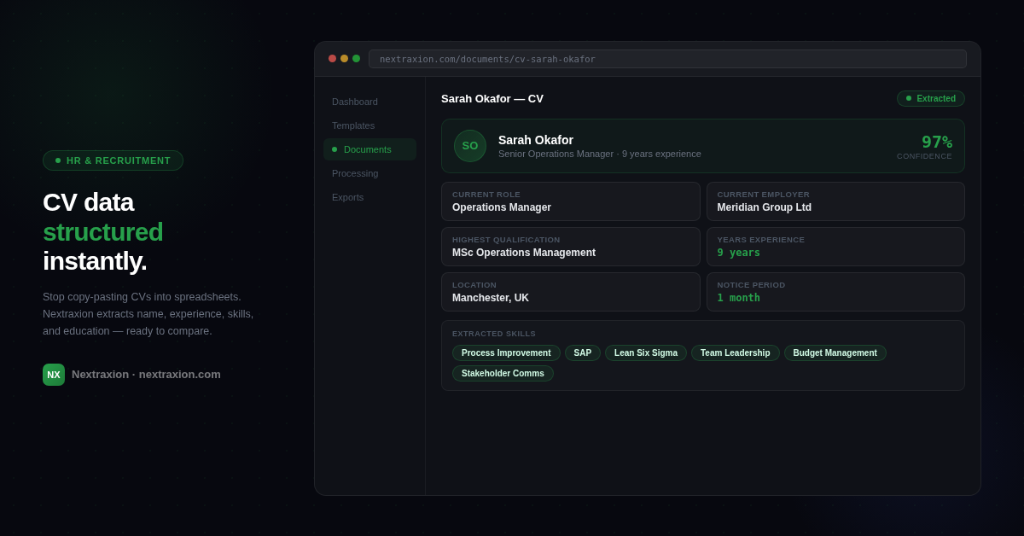
CV data extraction software removes that step. Candidate information is pulled automatically from each document into a consistent structure — so your team can compare, sort, and screen without the manual lifting.
What is CV data extraction?
CV data extraction is the automated process of reading candidate CVs or resumes and pulling structured data from them — name, contact details, work history, education, skills, and more. The output is a consistent set of fields for every candidate, regardless of how their CV was formatted.
Extraction tools use AI to interpret different layouts and label variations. "Mobile", "Tel", and "Contact Number" all map to the same phone field. "Most Recent Role", "Current Position", and a job title at the top of a work history section all resolve to the same output.
The result is clean, comparable data across your entire applicant pool. This is not the same as a keyword search or a pass/fail filter. Extraction gives you the raw data — what you do with it is your decision.
Why manual CV processing fails at scale
It takes too long. Reading and manually copying data from 100 CVs is hours of work for someone on your team. That time comes at the cost of other hiring tasks.
Formatting inconsistency makes comparison hard. One candidate lists their experience in years. Another lists job titles and dates but no duration. A third uses a visual layout where skills are embedded in a graphic. Getting apples-to-apples data requires effort that should not be necessary.
Details get missed. When a person is reading the fortieth CV in a row, attention degrades. A relevant qualification or language skill on page two of a busy document gets skipped. Extraction does not get tired.
Data entry into ATS is a second job. After reviewing a CV, someone still has to enter the candidate's details into your ATS or tracking spreadsheet. That is duplicate work. The CV already contains the data — it just needs to be read out of it.
What fields can be extracted automatically?
- Full name
- Email address
- Phone number
- Location / address
- Current job title
- Current employer
- Total years of experience
- Education: degree, institution, and graduation year
- Skills list
- Languages spoken
- LinkedIn profile URL
Custom fields can be added — for example, notice period, salary expectations if included in the document, or certifications relevant to your sector.
How it works in practice
- Upload the CVs — Drag and drop individual files or upload a batch. Nextraxion accepts PDF and Word document formats.
- Select your template — Choose the CV extraction template or customise the fields to match what your ATS or hiring spreadsheet requires.
- Extraction runs automatically — Each CV is processed in seconds, returning structured data for every candidate.
- Review the output — Results appear in a structured view. Check values, make corrections where needed, and approve before export.
- Export or connect — Download as CSV for import into your ATS or spreadsheet, or push directly via API.
Who uses this?
In-house HR teams use CV extraction to handle volume hiring without increasing headcount or burning out team members. When a campaign generates hundreds of applications, extraction means the shortlisting stage starts from clean data rather than from a stack of unprocessed documents.
Recruitment agencies use it to process candidate pools faster and build databases from CVs submitted across multiple clients and roles. Extracting once and storing structured data means candidates can be matched to future roles without re-reading old CVs.
Operations and people managers at growing businesses use it when HR is a small function and recruitment is shared across the team. When the founder or a line manager is also doing the hiring, any friction in the process costs real time.
Getting started with Nextraxion
Upload a sample CV, map the fields you want to extract, and save your template. The next time you run a hiring campaign, every CV goes through the same process and produces the same structured output — regardless of format.
The setup requires no technical knowledge and no developer time. If your team can use email, they can use Nextraxion. The first extraction takes under ten minutes from signup.
Frequently asked questions
What is CV parsing software?
Software that automatically reads candidate CVs and extracts structured data — name, contact details, work history, education, skills — handling different formats and layouts so your team gets consistent data for every candidate.
How accurate is automated CV extraction?
Typically above 90% on common fields for standard formatted CVs. Nextraxion returns a confidence score with each field so you can review anything that needs attention before importing.
What CV formats are supported?
PDF and Word documents. Heavily designed CVs using graphics or multi-column layouts may produce slightly lower accuracy.
What's the difference between CV extraction and an ATS?
An ATS manages the recruitment workflow. CV extraction is a data capture tool that reads CVs and returns structured data — the two work together, with extraction feeding clean data into your ATS and removing the manual entry step.
Is it GDPR compliant?
Nextraxion does not retain uploaded documents for model training. As data controller you remain responsible for obtaining candidate consent before processing through a third-party tool.
Can multiple CVs be processed at once?
Yes, batch uploads are supported — process a full application set in one session, all through the same template.
Try Nextraxion free — 75 credits, no credit card required.
First extraction in under 10 minutes.
Start free