Most businesses know that manually pulling data out of contracts is slow. What they don't always realise is exactly how much it's costing them — in staff time, in salary, and in the errors that slip through undetected.
This post breaks it down with real numbers, so you can make the comparison yourself.
The hidden cost of manual contract review
When someone on your team extracts data from a contract manually, they're not just reading a document. They're searching for specific information, interpreting legal language, deciding how to format what they find, and entering it into a spreadsheet or system. For a well-structured 10-page contract, that process takes roughly 15 minutes.
That might not sound like much. But multiply it by your contract volume.
At a US data entry wage of $15 per hour, 15 minutes of work costs $3.75 per contract. Process 1,000 contracts and you've spent $3,750 in labour — before accounting for management time, quality checks, or the cost of fixing mistakes.
And that's assuming everything goes smoothly. In practice, manual data entry has an error rate of 1–4%. On 1,000 contracts, that's potentially 10 to 40 records with incorrect or missing data — sitting silently in your system, waiting to cause a problem.
The time problem is just as serious
Labour cost is only part of the picture. The other issue is time.
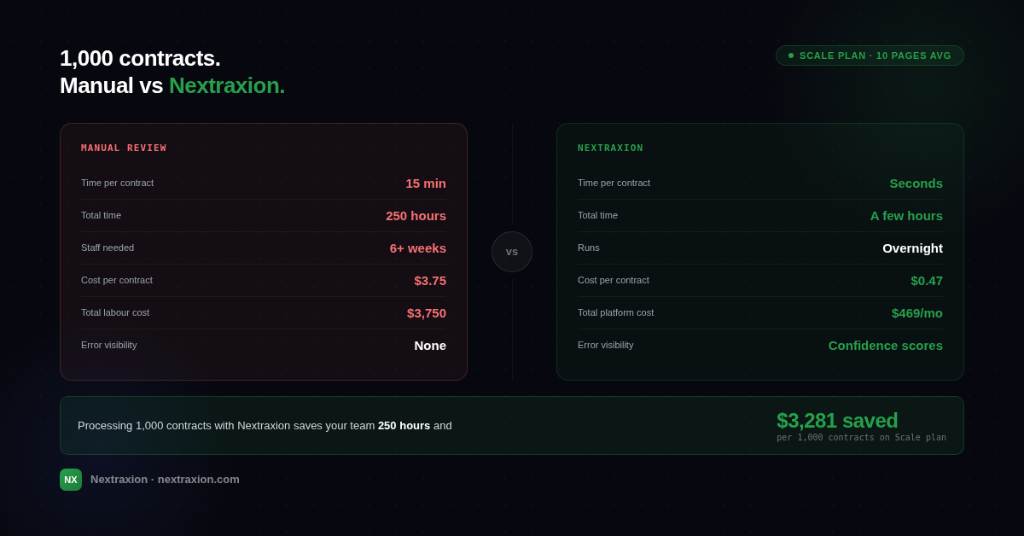
1,000 contracts at 15 minutes each is 250 hours of work. For a single person, that's more than six weeks. For a team of three, it's still over two weeks — and that's assuming contract review is their only task.
In fast-moving businesses, that delay has consequences. Contracts that haven't been reviewed sit in a queue. Deadlines get missed. Renewal dates slip past unnoticed. Payment terms go unchecked.
Speed matters — not because it's impressive, but because slow processes create gaps that cost money.
What contract data extraction actually costs
Nextraxion charges one credit per page. Here's what that means across each plan for a 10-page contract:
| Plan | Credits | Price | Cost per 10-page contract |
|---|---|---|---|
| Trial | 75 | Free | Free |
| Starter | 500 | $69/month | $1.38 |
| Growth | 2,500 | $199/month | $0.80 |
| ScaleBest value | 10,000 | $469/month | $0.47 |
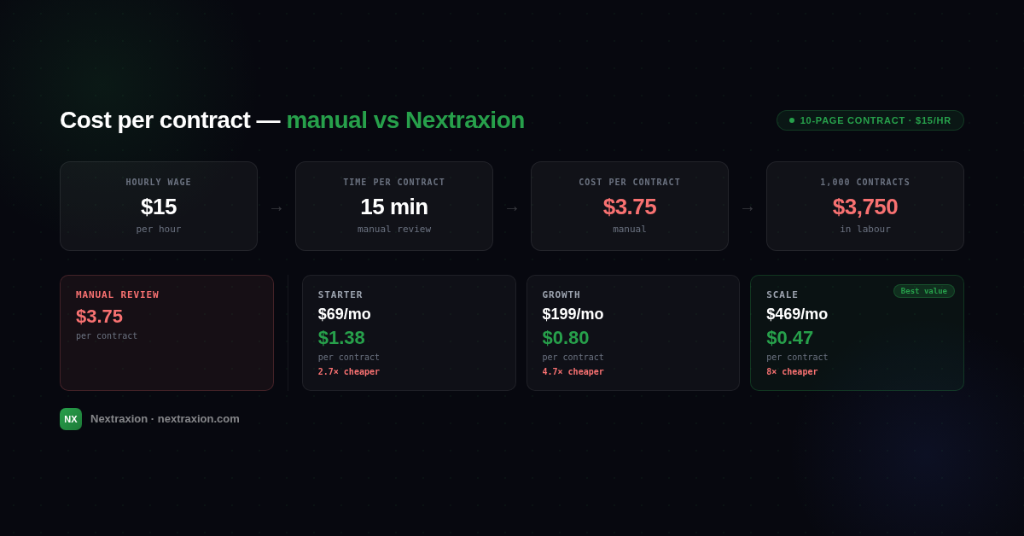
Even on the Starter plan, you're paying $1.38 per contract compared to $3.75 manually — nearly three times cheaper. On the Scale plan that drops to $0.47 per contract, an eight times saving on labour cost alone.
On the time side, Nextraxion processes documents in parallel — up to three at a time, automatically. 1,000 contracts don't take six weeks. They take a few hours, running in the background while your team focuses on higher-value work.
Manual vs extraction — side by side
| Manual review | Nextraxion | |
|---|---|---|
| 1,000 contracts (10 pages) | 250 hours | A few hours |
| Labour cost | $3,750 | — |
| Platform cost | — | $69–$469/month |
| Error visibility | Undetected until found | Flagged with confidence scores |
| Consistency | Varies by person | Same rules every time |
What about accuracy?
Manual data entry doesn't fail loudly. A transposed date, a missed payment term, a contract value entered in the wrong currency — these errors don't announce themselves. They sit in your data until someone finds them, or until they cause a problem.
Contract data extraction doesn't eliminate the need for human judgement — but it makes uncertainty visible. Every extracted field comes back with a confidence score. High-confidence fields can be approved quickly. Lower-confidence fields get flagged for a human check. You're not reviewing everything — you're reviewing the things that actually need attention.
That's a fundamentally different model to manual review, where the error rate is invisible and the review process is inconsistent.
When does manual review still make sense?
For very low contract volumes — a handful of documents a month — the setup time for an extraction template may not be worth it. And for highly bespoke, one-off agreements that don't follow a consistent structure, human reading is still valuable.
But for any business processing contracts at volume — tens, hundreds, or thousands per month — manual review doesn't scale. The labour cost grows linearly with volume. The error risk grows with it. And the time required never gets shorter.
Good contract data extraction software scales differently. The cost per contract stays the same whether you're processing 10 or 10,000. The time stays roughly the same. And the quality stays consistent.
The bottom line
The difference isn't just cost. It's speed, consistency, and the ability to catch errors before they become problems.
Manual contract review costs $3.75 per contract in labour at $15/hr. At volume, that adds up fast — $3,750 for 1,000 contracts, compared to as little as $0.47 per contract with Nextraxion.
If you're still processing contracts manually, the numbers make the case better than we can.
Frequently asked questions
See the difference for yourself
75 free credits. No credit card required. Process your first contracts today.
No credit card required
Questions about pricing? hello@nextraxion.com